The GRE Verbal Reasoning section loves testing obscure vocabulary. Even though the shorter GRE (launched September 2023) cut the total number of scored Verbal questions from 40 to 27, vocabulary still matters. Arguably it matters more, because every Sentence Equivalence and Text Completion question now carries more weight.
So which word lists should you actually study?
The short answer: Use a focused list of 1,000 or so high-frequency words from a reputable, actively maintained source, like Magoosh’s GRE Vocabulary Flashcards, Manhattan Prep’s 1,000 Words, or GregMAT’s semantic groups. Avoid sprawling 3,500-word lists and random word dumps you find online.
The rest of this post explains why: what makes a list good or bad, how to actually memorize the words, and the top 20 words to start with today.
When and how vocab is tested on the GRE
GRE words appear only in the Verbal Reasoning sections. There are three question types, all multiple choice:
- Reading Comprehension: read a passage and answer questions about it. Some questions are “vocabulary in context,” but they test less-common meanings of familiar words more than direct definitions.
- Sentence Equivalence: read a sentence with one blank, pick two answer choices (out of six) that produce sentences with the same meaning. Direct vocabulary test.
- Text Completion: read a sentence with one, two, or three blanks and pick the choice (or combination) that best fits. Heavy on vocabulary plus sentence logic.
Sentence Equivalence and Text Completion are where vocabulary pays off most. With only 27 scored Verbal questions on the entire test, missing even one or two vocabulary-driven questions can pull your score down a band. That’s why a tight, high-frequency word list beats a sprawling one: you get bigger returns from the words that actually show up.
Table of contents
Table of Contents
What makes a GRE word list worth your time
Before recommending anything, it helps to name the criteria. A good GRE word list does three things:
- Reflects the current GRE. The test changes. Analogies were retired in 2011. The format shortened in 2023. A list built around old question types, or one that has never been re-evaluated, wastes your time on words you won’t see.
- Defines words you can actually use. Short, contextual definitions with example sentences beat dictionary entries every time. The GRE tests how a word functions in a sentence, not just its denotation.
- Is actively maintained. Test content evolves, student response data accumulates, and good publishers update accordingly. A list last touched a decade ago is teaching you yesterday’s test.
With those criteria in mind, here are the lists worth your time, and the ones to skip.
The best and worst GRE word lists
Knowing the highest-frequency GRE words gives you the biggest score-per-hour return. To break into the top scores, you’ll need to know hundreds of them well, not just recognize them.
We recommend:
- Magoosh GRE Vocabulary Word Lists (PDF)
- Magoosh GRE Vocabulary Flashcards App
- Magoosh GRE Vocabulary Builder App
- GregMAT’s semantic word groups (1,110 words organized into 47 meaning-based groups)
- Vocabulary.com’s GRE list (interactive practice with real-world example sentences)
- Kaplan’s 900 Words
- Barron’s 1,100 Words
- Princeton Review’s Word Smart
We do not recommend:
- Barron’s 3,500 and 4,759 word lists
- Nova’s 4,500
- Random word lists you find online
More on the best GRE word lists
Magoosh GRE Vocabulary Word Lists PDF
Magoosh’s GRE Vocabulary PDF is one of the more useful free vocab resources you’ll find. It collects 300+ of the most common GRE words into themed mini-lists (most commonly missed words, money words, and so on), which makes them easier to retain than alphabetical lists. The same words feed into our flashcard and builder apps for practice.

Magoosh GRE Vocabulary Flashcards App
Magoosh’s GRE Vocabulary Flashcards teach over 1,000 high-frequency words, organized into common, basic, and advanced decks. The app tracks which words you know and resurfaces the ones you miss.
This list isn’t static. In the past year we reassessed it against the top vocabulary lists on the market and against current GRE content, then expanded coverage. Most competitor lists were written years ago and haven’t been touched since, which is exactly the maintenance problem we flagged above.
Magoosh GRE Vocab Builder App
A natural complement to the flashcards, the Magoosh Vocabulary Builder uses multiple-choice questions to test your knowledge in context (rather than just definition recall). Like the flashcards, it organizes words by difficulty and tracks the ones you need to review.
GregMAT’s Semantic Word Groups
If you’ve spent time on r/GRE, you’ve seen GregMAT recommended constantly, and for good reason. The approach groups roughly 1,110 high-frequency words into 47 clusters by meaning (“words meaning talkative,” “words meaning to praise,” and so on), which is closer to how vocabulary actually lives in your head than alphabetical order. It pairs well with flashcards: use semantic groups to build associations, then drill the individual words.
Vocabulary.com’s GRE List
Vocabulary.com’s 900+ Essential GRE Words is a strong supplementary resource. The platform pulls example sentences from real publications (NYT, Forbes, Scientific American), so you see each word the way you’ll encounter it on a GRE Reading Comp passage, not in isolation. It’s most useful as a second pass after you’ve worked through a core list.
Other respectable GRE word lists
If you’ve already been working with any of these, you’re in fine shape:
- Kaplan’s 900 Words
- Barron’s 1,100 Words
- Princeton Review’s Word Smart
All three focus on high-frequency words and have stood the test of time.
Pro tip: Don’t stack three or four lists in parallel. Pick one core list (Magoosh, Manhattan, or GregMAT) and work through it deeply. Use a second list only as a supplement for words you keep missing.
The worst GRE word lists
Barron’s 3,500 and 4,759 Word Lists
If you come across these older Barron’s lists, set them aside. Hundreds of words are crammed onto each page, definitions are vague, and the words aren’t shown in context. Slog through them and you’ll have no way to tell high-frequency from low-frequency, which is the entire point of building a vocab list.
Nova’s 4,500
This list lives in Nova’s verbal book. Words are vaguely defined (and sometimes wrong), with no frequency tagging. Common GRE words sit next to words you’ll never see in a question. There’s no better way to waste vocabulary prep time.
Random internet word lists
These are everywhere, and most of them either copy from older lists or pad themselves with archaic words. If you can’t tell who wrote the list, when, or against what criteria, skip it.
How to approach GRE word lists
How to memorize GRE word lists
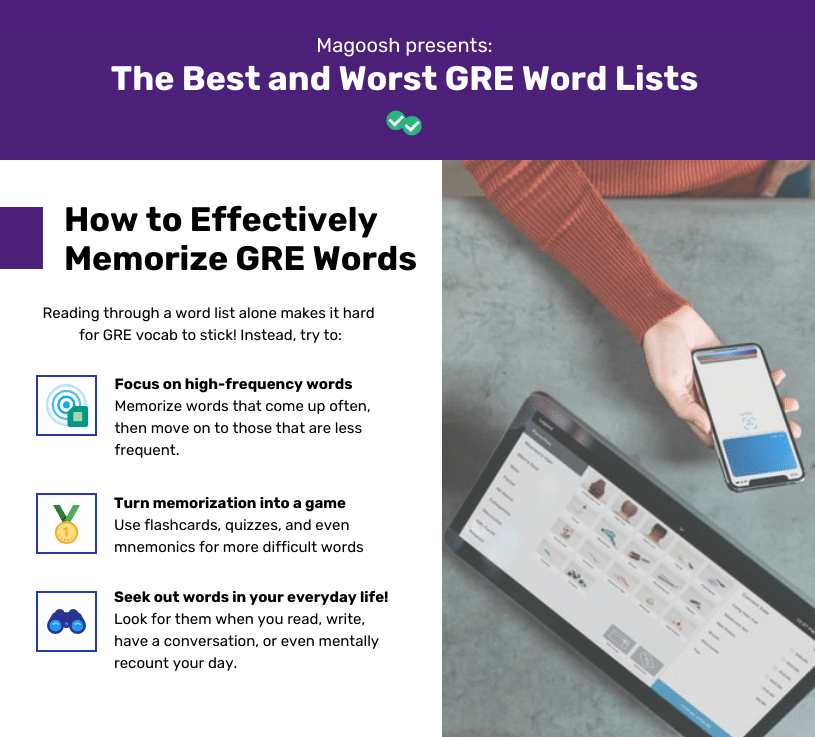
The key to memorizing new vocabulary, or anything really, is to take an active approach rather than a passive one. Do not just read through a list of unknown words.
Our brains learn from being challenged. When you read a word and then read its definition, you aren’t challenging anything. Quiz someone 30 minutes after they’ve read a vocab list and they might remember the placement of words (“stymie was next to esoteric, or maybe esoter…something…”), but recalling the definitions is much harder.
A few tips to help you actually memorize new GRE words:
- Focus on high-frequency words first. As you practice, note which words come up repeatedly. Master those before chasing lower-frequency words.
- Group related words together. Learning loquacious, garrulous, voluble, prolix as a cluster of “talkative” words sticks better than learning them in alphabetical order across a 1,000-word list. This is the core of the GregMAT approach.
- Make it a game. Use flashcards and quizzes, and build mnemonics for tricky words.
- Seek out the words in your everyday life. Look for them in articles you’re reading (read challenging stuff: NYT, Aeon, Arts & Letters Daily). Use them in your own writing. If you can find a way to slide them into conversation without sounding pompous, even better.
Making the most of GRE word lists
The internet is full of free tools that turn static word lists into something you can actually drill: quizzes, flashcards, matching games, spaced-repetition apps. A few worth knowing about:
- Anki: The gold standard for spaced repetition. Community-made GRE decks combine GregMAT, Manhattan Prep, and Magoosh lists. Steeper learning curve than Quizlet but more effective for long-term retention.
- Quizlet: Easier to start with. Hundreds of GRE decks already exist; pick one that maps to a list you trust (otherwise you’re memorizing someone’s random word collection).
- Vocabulary.com: Interactive, gamified, with example sentences from real publications.
- Wordnik: Looks up any word and links to blogs and articles where it appears in context. Useful for seeing how a word lives in the wild.
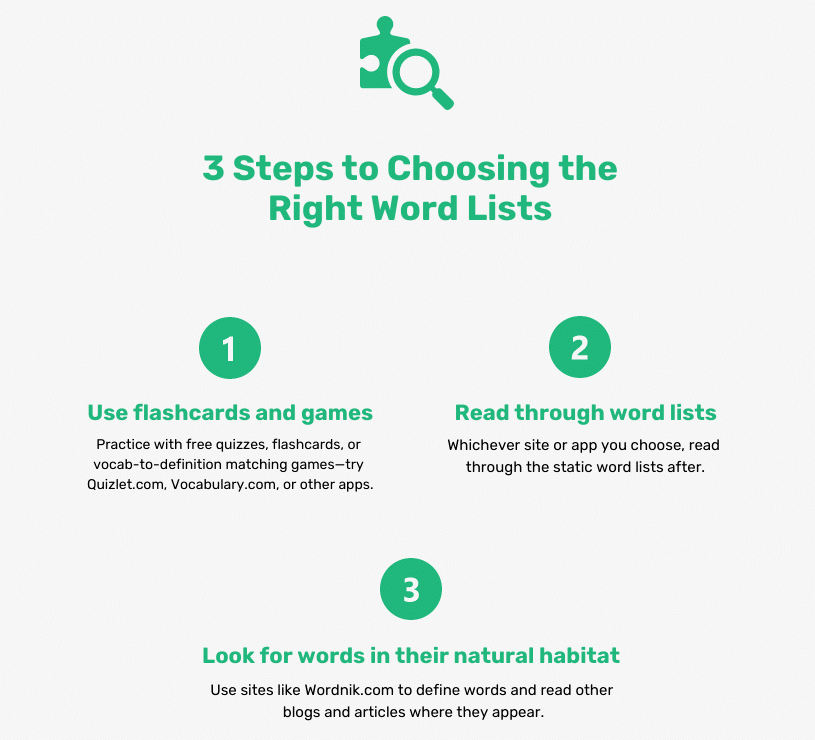
A workflow that holds up:
- Drill the words through flashcards or a spaced-repetition app first. This is where most of the learning happens.
- Read through the static list periodically to reinforce what you’ve drilled and fill in context that flashcards miss (example sentences, word roots).
- Hunt for the words in real reading. Encountering “ephemeral” in a Times piece does more for retention than seeing it on a flashcard for the 20th time.
Still struggling with vocabulary? Our guide to how to study GRE vocabulary goes deeper on the tactics above, with worked examples.
Top 20 most tested GRE words
Now for the fun part. Here are 20 high-frequency GRE words to start with. Read each word, predict the definition before clicking, then check yourself.
- Ambivalent (adj.)
Click here for the definition
Having contradictory feelings.
Erin was ambivalent about her freshman year in college: her classes were fascinating, but she missed her high school friends.
- Auspicious (adj.)
Click here for the definition
Favorable.
The team’s run for the pennant started auspiciously with 24 wins. Then two starting pitchers snapped their elbows mid-season, clearly an inauspicious sign.
- Belligerent (adj.)
Click here for the definition
Inclined to fight.
After a few drinks Stevie was convivial; after two six-packs he became belligerent, challenging anyone around him to a head-butting contest.
- Capricious (adj.)
Click here for the definition
Unpredictable, whimsical.
Because Mario was so capricious, his friends felt they could not rely on him.
Test yourself: try a question using capricious.
- Corroborate (v.)
Click here for the definition
To confirm, make stronger.
Three witnesses were able to corroborate Lucy’s alibi that she had been at the bowling alley at the time of the murder.
- Enervate (v.)
Click here for the definition
To weaken; drain the energy from.
Sitting in the windowless room, the tropical humidity soaking through the walls, I was enervated before noon.
- Ephemeral (adj.)
Click here for the definition
Short-lived.
YouTube has made fame truly ephemeral. Just ask Rebecca Black.
- Erudite (adj.)
Click here for the definition
Scholarly.
A Rhodes Scholar, Maxine was a true erudite, and a formidable opponent on Jeopardy.
Test yourself: try a question using erudite.
- Esoteric (adj.)
Click here for the definition
Known to a select few.
Many jazz artists once deemed esoteric have emerged thanks to the greater access listeners now have to avant-garde music online.
Test yourself: try a question using esoteric.
- Extant (adj.)
Click here for the definition
In existence (most commonly referring to texts).
Few documents predating the advent of papyrus are extant today.
- Fastidious (adj.)
Click here for the definition
Nitpicky.
A fastidious eater, Herman would only eat the center of anything he touched. His plate was strewn with the remnants of his dinner, an eyesore for the hapless dinner guest.
- Inculpate (v.)
Click here for the definition
To charge with wrongdoing; accuse.
To inculpate Eddy with the murder was absurd; he’d been bowling with Lucy.
- Loquacious (adj.)
Click here for the definition
Talkative.
Carl was so loquacious his friends usually didn’t like to watch a movie with him.
- Magnanimous (adj.)
Click here for the definition
Big-hearted; generous.
Upon receiving his first Wall Street paycheck, Jerry was so magnanimous he not only bought his mom a car, he bought his dad one too.
- Mercurial (adj.)
Click here for the definition
1. Changing one’s personality often and unpredictably. 2. Animated, sprightly.
One never knew exactly what the professor’s class would be like; he was so mercurial that many of his students thought of him as two different people.
- Pragmatic (adj.)
Click here for the definition
Practical.
Edna never cared for abstract thinking and preferred the pragmatic world of business, in which every action, ideally, has an intended consequence.
- Prolific (adj.)
Click here for the definition
Producing or creating abundantly.
Irving Berlin had one of the most prolific careers in songwriting history. Dozens of his hundreds of tunes are still familiar today. Anyone dreaming of a “White Christmas?”
- Reticent (adj.)
Click here for the definition
Tight-lipped; not prone to saying much; reluctant.
Paul was reticent and preferred observing others’ mannerisms.
- Sanguine (adj.)
Click here for the definition
Cheerful; optimistic.
A Yale graduate with a 4.0, she was sanguine about finding a job right out of college.
- Soporific (adj.)
Click here for the definition
Inducing sleep.
Professor Moore’s lectures were soporific to the point that students, before they nodded off in class, would usually quip, “It’s time for Professor Bore.”
Putting it all together
You don’t need every GRE word list. You need one good one, drilled deeply, with help from a couple of supplements. Pick a core list from an actively maintained source (Magoosh, Manhattan Prep, GregMAT). Drill it with spaced repetition (Anki, Quizlet, or our flashcard app). Look for the words in real reading. Group them by meaning when you can.
Then put your vocab to the test on a full-length free GRE practice test from Magoosh. You can do the Verbal section alone or sit a full exam, and you’ll get a detailed score report with a topic-by-topic breakdown. Happy studying.